


Everyone said AI would kill design agencies. Two years later, the real answer is more complicated — and honestly, more interesting.
Let’s be real about where we are
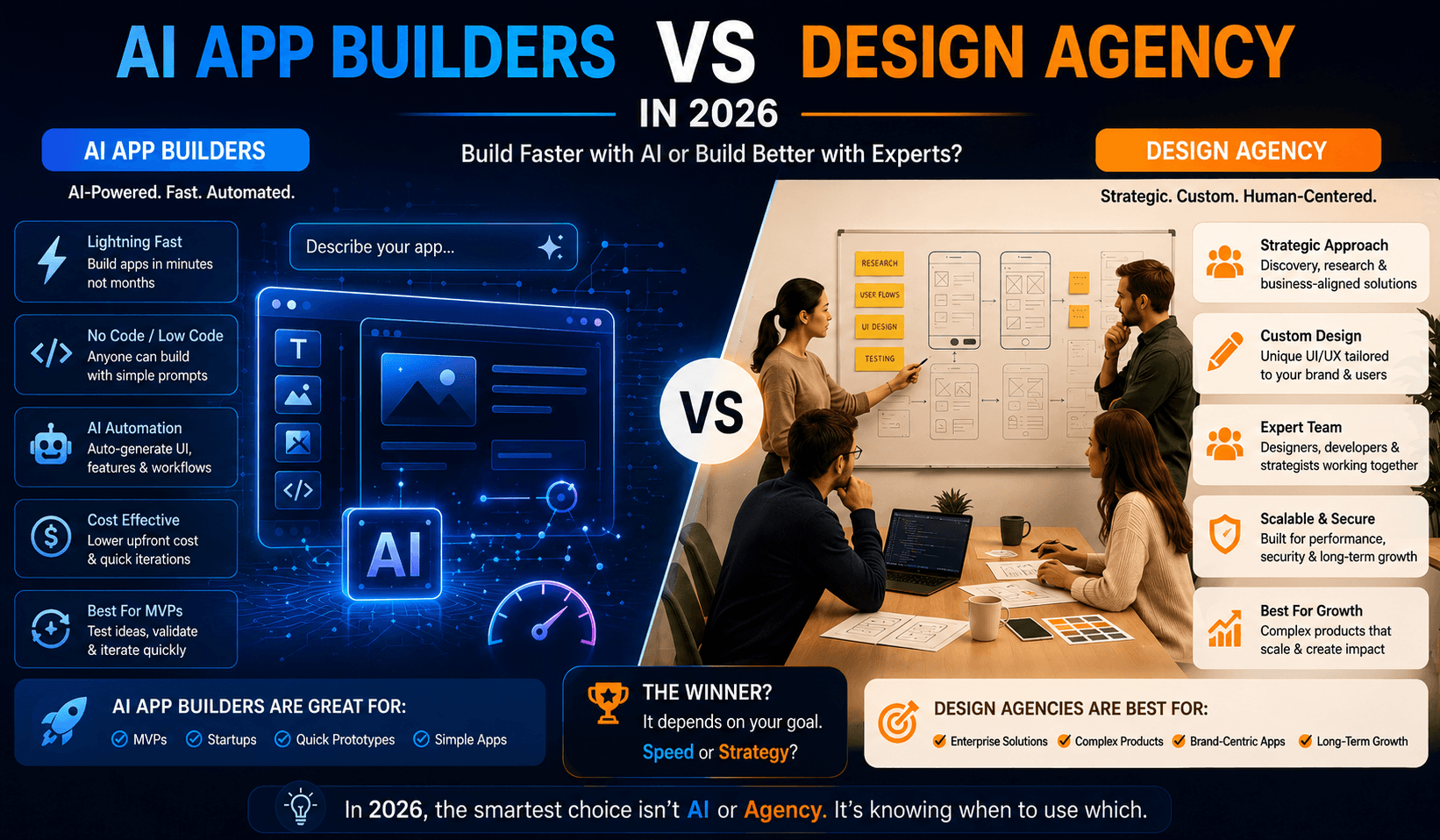
The conversation used to be “will AI replace designers?” That conversation is over. In 2026, the real question is: when do you reach for an AI app builder, and when do you call a UI UX design agency?
Businesses are no longer choosing one or the other out of philosophy. They’re choosing based on what the project actually needs. And that nuance is what most hot-take articles completely miss.
Case For AI
Where AI app builders genuinely win
AI-powered builders have gotten scarily good at the mechanics of user interface design. Prompt-to-prototype in minutes. Consistent component libraries. Auto-responsive layouts. If you’re a founder validating an idea, a startup racing to MVP, or an internal team building a dashboard nobody outside the company will ever see — an AI builder might be exactly what you need.
“Speed is a feature. An AI tool that ships a working prototype in 4 hours vs a 6-week agency sprint isn’t always the worse option — it depends on the stage you’re at.”
The economics are undeniable. AI tools charge flat monthly fees. A proper UI UX design company engagement can run $15K–$80K+ for a full product design cycle. For early-stage companies, that math doesn’t work.
4h Average AI builder prototype time
~$0 Marginal cost for AI iterations
∞ Design variations at no extra cost
Case For Agency
Where a UI UX design agency is irreplaceable
Here’s the thing AI can’t do: it can’t sit in a room with your users, watch them struggle with your product, and come back with insights that reshape your entire product strategy. User experience design at its best is a research discipline, not a visual one.
A seasoned UI UX design services team brings ethnographic research, stakeholder alignment workshops, accessibility expertise, and cross-industry pattern recognition. These aren’t prompts — they’re relationships, intuition, and craft built over years.
And for products where user experience design is the product — think healthcare apps, fintech, enterprise SaaS — a poorly designed flow isn’t just ugly. It’s a liability.
“AI builds interfaces. Agencies design experiences. The difference shows up in retention metrics six months after launch.”
Head to Head
The honest comparison
|
AI Builders: Strong At |
Agencies: Strong At |
|---|---|
|
Speed, iteration volume, cost efficiency, basic user interface design, component consistency, simple flows, MVPs, internal tools, landing pages. |
User research, complex product strategy, brand-defining experiences, accessibility, enterprise UX, stakeholder management, novel interaction paradigms. |
|
AI Builders: Weak At |
Agencies: Weak At |
|
Deep user empathy, edge-case thinking, nuanced brand expression, research synthesis, explaining design decisions to non-technical stakeholders. |
Rapid low-stakes iteration, cost-per-revision, speed-to-screen, infinite design variations, scaling output without proportionally scaling cost. |
The smartest teams are doing both
In 2026, the false choice is over. The most effective product teams use AI builders to move fast in discovery — testing hypotheses, exploring layouts, validating concepts cheaply. Then they bring in a UI UX design company to deepen the work that matters: the flows that drive conversion, the onboarding that reduces churn, the interface that makes the product feel like it was made for someone.
Think of it this way: AI gets you to the starting line faster. A great UI UX design agency helps you win the race.
The Verdict
Stop asking “which one” — start asking “when”
Use AI app builders when speed and cost dominate the decision. Use a UI UX design agency when the quality of user experience design is directly tied to business outcomes.
The brands winning right now aren’t the ones who picked a side. They’re the ones who understood that user interface design done by AI and user experience design done by humans serve different jobs — and deployed each accordingly.