




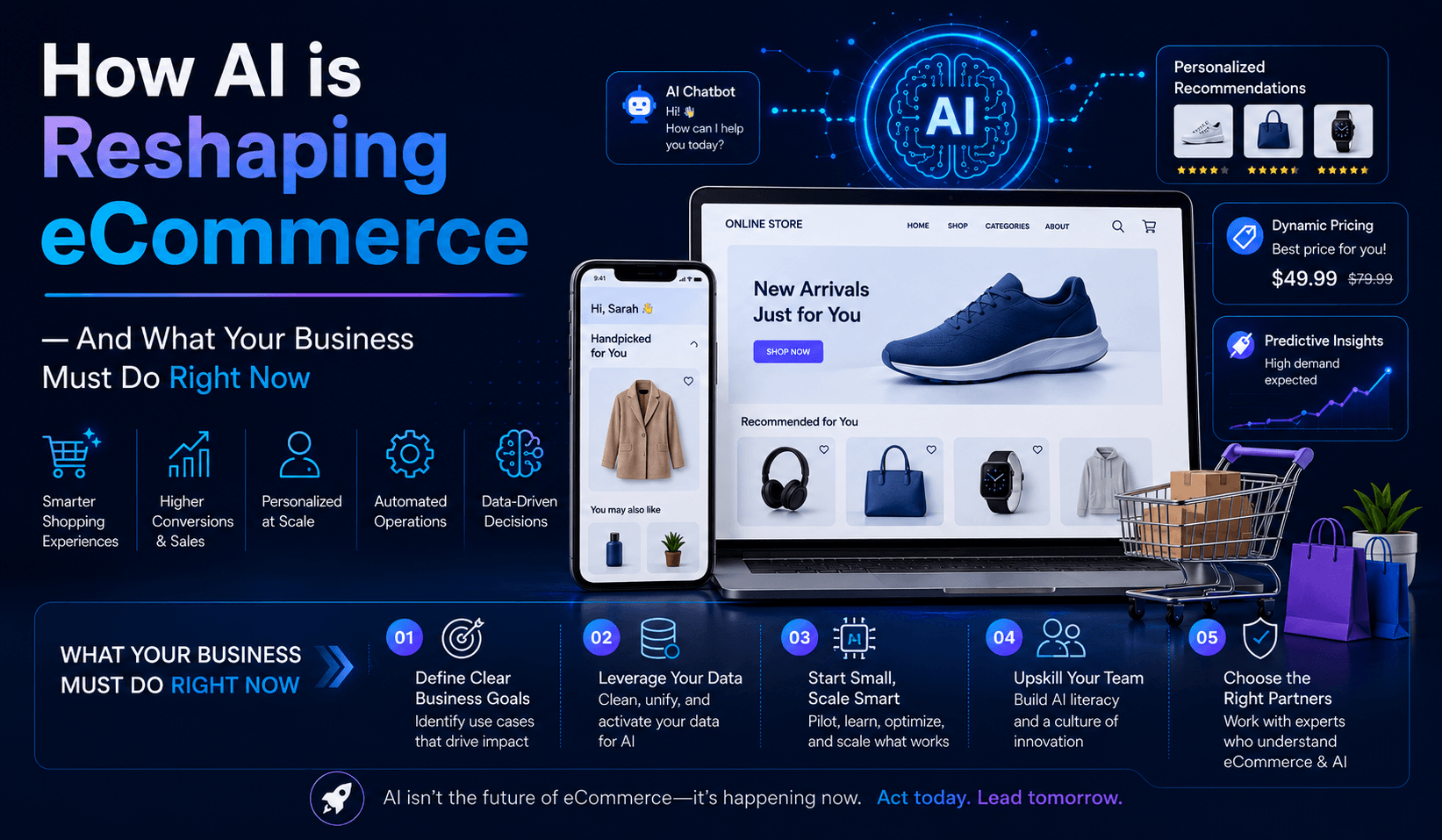
The eCommerce Landscape Has Changed Forever
The digital marketplace is no longer what it was five years ago — or even last year. Artificial intelligence has quietly moved from a buzzword on whitepapers to the beating engine behind the world's most profitable online stores. From hyper-personalised product recommendations and AI-driven inventory forecasting to intelligent chatbots and predictive pricing, AI is rewiring every layer of how eCommerce operates.
If you own or manage an online store, this is not a trend you can afford to observe from the sidelines. Businesses that are partnering with a forward-thinking ecommerce website development company to embed AI into their platforms are pulling ahead — dramatically. Those that aren't are losing ground to smarter, faster, more adaptive competitors.
This guide breaks down exactly what AI is doing to eCommerce right now, what the biggest opportunities are, and — most importantly — what actionable steps your business needs to take today.
1. AI-Powered Personalisation: The End of the Generic Shopping Experience
Gone are the days of showing every visitor the same homepage, the same product catalogue, and the same promotions. AI-driven personalisation engines analyse thousands of data signals — browsing history, purchase patterns, geolocation, device type, time of day — and serve each visitor a dynamically tailored experience in real time.
Consider these numbers:
35% of Amazon's total revenue is driven by its AI recommendation engine.
Personalised product suggestions can increase average order value by up to 26%.
Stores with AI personalisation see cart abandonment rates drop by as much as 18%.
What does this mean for your business? It means that if your product pages, email flows, and homepage are static, you are already operating at a significant disadvantage. Modern ecommerce web development now routinely incorporates AI recommendation layers — but only if you work with a team that understands how to build and integrate them correctly.
Action point: When evaluating an ecommerce development company, ask specifically about AI personalisation capabilities, recommendation engine integrations (such as Nosto, Bloomreach or custom ML pipelines), and how they approach dynamic content delivery based on user segmentation.
2. Conversational Commerce: AI Chatbots & Voice Search Are Closing Sales
Customer expectations have changed sharply. Shoppers expect instant answers at 2 AM on a Sunday. They expect product guidance that feels human. They expect seamless conversations across chat, voice, and messaging apps.
AI-powered chatbots and virtual shopping assistants are now capable of:
- Answering detailed product questions with contextual awareness
- Guiding shoppers through complex purchase decisions
- Recovering abandoned carts with personalised re-engagement messages
- Processing returns and exchanges without human intervention
- Upselling and cross-selling based on real-time basket analysis
Voice commerce is accelerating in parallel. With smart speaker adoption growing globally and voice search now accounting for a significant share of product discovery queries, optimising your store for conversational, natural-language queries is becoming a core part of ecommerce web development strategy — not an optional extra.
Action point: Your eCommerce platform needs to be built (or rebuilt) with conversational commerce in mind. This means structured data, voice-search-optimised product copy, and AI chat integration. A capable custom ecommerce development partner will factor these into your architecture from day one, not bolt them on afterward.
3. Visual Search & AI Product Discovery
Type-based search is losing ground. Shoppers — especially mobile users — increasingly want to photograph a product and find it instantly. AI-powered visual search engines like Google Lens, Pinterest Lens, and proprietary in-store visual search tools are transforming product discovery.
For eCommerce businesses, this creates both an opportunity and a risk:
Opportunity:Brands that optimise for visual search — using high-quality images, proper image alt tags, structured product data, and AI-tagging — gain a new acquisition channel that competitors haven't fully exploited yet.
Risk : Brands with poor image infrastructure, inconsistent product photography, or legacy platforms that don't support visual search metadata will become invisible to a growing segment of shoppers.
This is one reason why custom ecommerce developmentis growing in strategic importance. Off-the-shelf platforms offer limited control over how AI systems index and interpret your
product catalogue. Custom-built platforms allow development teams to implement schema markup, AI image tagging pipelines, and visual search integrations that significantly expand your product discovery footprint.
4. Predictive Analytics & Smarter Inventory Management
One of AI's most commercially significant contributions to eCommerce is behind the scenes: predictive demand forecasting. Traditional inventory management is reactive — businesses stockpile based on last season's data or gut feel. AI changes this entirely.
Modern AI systems can:
- Predict demand spikes weeks in advance by analysing market trends, weather patterns, social media signals, and historical data simultaneously
- Automatically reorder stock before shortages occur
- Identify slow-moving inventory and trigger automated discounting to free up capital
- Optimise warehouse slot allocation in real time
For mid-market and enterprise eCommerce businesses, integrating predictive analytics into the platform stack — through tools like Blue Yonder, Netstock, or custom ML pipelines — is a competitive necessity. An experienced ecommerce website development company with deep technical capability can architect these integrations seamlessly into your existing operational workflows.
Action point: When scoping your next eCommerce project, don't think of the platform in isolation. Think about the full ecosystem: your ERP, your warehouse management system, your supplier feeds. A sophisticated ecommerce development company will design your platform to communicate intelligently with all of these, not just present a front-end shopping experience.
5. Dynamic Pricing: Competing at the Speed of the Market
In traditional retail, pricing decisions happen slowly — seasonal reviews, promotional calendars, manual competitor analysis. In AI-powered eCommerce, pricing moves in real time.
Dynamic pricing algorithms monitor competitor prices, demand signals, conversion rates, and margin thresholds simultaneously — and adjust your prices automatically to maximise revenue without sacrificing competitiveness. Airlines and hotels have used dynamic pricing for decades. eCommerce is now democratising this capability for businesses of all sizes.
The results can be significant: studies show dynamic pricing strategies can increase gross margin by 5–15% while simultaneously improving conversion rates during high-demand periods.
Implementing a dynamic pricing layer requires thoughtful ecommerce web development — the architecture must support rapid price updates across your catalogue without compromising site
performance, creating SEO issues with fluctuating price data, or triggering customer trust concerns.
Action point: Discuss dynamic pricing architecture early in any platform development conversation. The decisions made at the database and API layer will either enable or block this capability later.
6. AI-Generated Content & SEO at Scale
Running a large eCommerce catalogue means managing thousands — sometimes tens of thousands — of product descriptions, meta titles, category pages, and blog content pieces. Traditionally, this created a stark choice: invest in enormous content teams, or live with thin, duplicate, or missing content.
AI content generation tools have changed this equation. AI can now:
- Generate SEO-optimised product descriptions at scale from structured product data
- Create category page content that targets long-tail keyword clusters
- Draft and A/B test email subject lines and body copy automatically
- Produce localised content variants for different regional markets
For businesses operating across multiple geographies, this is especially powerful. AI-generated, locally adapted content — properly reviewed and refined by human editors — allows a single marketing team to maintain high-quality, locally relevant content across dozens of markets simultaneously.
This connects directly to how AI is transforming the role of an ecommerce development company: development teams that understand SEO architecture, content APIs, and AI content tooling are increasingly essential partners in growth, not just technical vendors.
7. Fraud Detection & Secure Transactions
As eCommerce volumes grow, so does fraud. Chargebacks, account takeovers, fake reviews, and payment fraud cost the global eCommerce industry tens of billions of dollars annually.
AI fraud detection systems have become the standard defence. Unlike rule-based fraud filters that generate high false-positive rates and frustrate legitimate customers, AI systems learn continuously — identifying subtle, evolving patterns of fraudulent behaviour while letting genuine transactions flow through without friction.
Modern AI fraud tools operate at millisecond speed, analysing hundreds of signals per transaction: device fingerprint, IP behaviour, historical account patterns, velocity checks, and behavioural biometrics (how a user moves their mouse, how they type, how long they spend on pages).
Embedding robust fraud detection is a non-negotiable part of responsible custom ecommerce development. Any platform that handles financial transactions must be built with AI fraud prevention integrated into the payment flow architecture — not added as a superficial afterthought.
8. The Rise of Headless & Composable Commerce
AI is also catalysing a fundamental shift in how eCommerce platforms are architecturally built. The old model — monolithic platforms where front-end, back-end, and business logic are tightly coupled — is increasingly unable to support the speed and flexibility that AI-powered commerce requires.
Headless and composable commerce architectures are taking over. In this model:
- The front-end presentation layer is decoupled from the commerce engine
- AI tools, personalisation engines, pricing systems, and content platforms are composed together through APIs
- Each component can be updated, replaced, or scaled independently without disrupting the whole system
This is why custom ecommerce development has surged in demand among businesses with serious growth ambitions. SaaS platforms can take you only so far before their rigid architecture becomes a ceiling. Custom-built, composable platforms give businesses the flexibility to integrate AI capabilities as they emerge — without waiting for a platform vendor's roadmap.
When selecting an ecommerce website development company, ask how they approach composable architecture. Teams that still think in terms of rigid, monolithic platform builds will struggle to deliver the agility your AI strategy requires.
9. Localisation & Geo-Targeting: AI Makes Global Commerce Personal
One of AI's most powerful and underutilised capabilities in eCommerce is intelligent localisation. Global eCommerce is no longer just about translating your website into another language. It involves:
- Serving localised pricing in local currency with AI-driven currency conversion and regional pricing strategies
- Adapting product assortments based on regional demand patterns
- Delivering geo-targeted promotions based on local events, seasons, and holidays
- Optimising logistics and delivery messaging based on regional carrier performance
- Displaying localised social proof — reviews and ratings from customers in the shopper's region
AI makes all of this possible at a scale that was previously only accessible to large enterprises. Mid-market businesses working with the right ecommerce development company can now implement sophisticated geo-targeting and localisation layers that personalise the experience right down to the city level.
For businesses targeting markets in South Asia, Southeast Asia, the Middle East, or other high- growth regions, localisation is not optional — it is the primary growth lever. Audiences in these markets convert significantly higher when the experience feels natively local rather than a translated afterthought.
10. What Your Business Must Do Right Now
AI is not coming to eCommerce — it is already here, already embedded in the platforms your competitors are using, already influencing which businesses win the next decade of digital commerce. The window to get ahead is open, but it is not indefinitely wide.
Here is your action framework:
Step 1— Audit your current platform. Evaluate honestly whether your existing eCommerce platform can support AI integrations, personalisation engines, dynamic pricing, and composable architecture. If it can't, waiting will only make the migration more costly.
Step 2 — Partner strategically, not just technically. The difference between a vendor and a strategic partner is significant. Choose an ecommerce website development company that understands AI strategy, data architecture, and commercial growth — not just front-end design and theme customisation.
Step 3 — Invest in custom where it matters. Not every business needs a fully bespoke platform. But for businesses with complex catalogues, multi-market operations, or high transaction volumes, custom ecommerce development delivers a long-term competitive advantage that off- the-shelf solutions cannot match. Custom architecture means control — and in an AI-driven landscape, control over your data and your stack is foundational.
Step 4 — Think in ecosystems, not platforms. The era of the single eCommerce platform doing everything is over. Your future stack will be composable — the best search tool, the best AI personalisation engine, the best payment processor, and the best fulfilment integration, all orchestrated together through expert ecommerce web development.
Step 5 — Start collecting better data now. AI is only as powerful as the data it learns from. Begin auditing your data infrastructure today: what customer data are you collecting, how is it stored, how is it structured, and is it actually usable by AI systems? Every month you delay is a month of valuable training data you don't have.
Choosing the Right eCommerce Development Partner for the AI Era
The most important decision you will make in your eCommerce AI journey is who you partner
with to build and evolve your platform. The wrong partner — one focused only on delivering a live website rather than engineering a growth platform — will create technical debt that hobbles your AI strategy before it begins.
The right ecommerce development company will:
- Bring deep expertise in modern API-first and headless architectures
- Have demonstrable experience integrating AI and ML tools into production eCommerce environments
- Understand SEO implications of every technical decision
- Build for performance, scalability, and composability from the first line of code
- Act as a commercial partner invested in your growth metrics, not just your project delivery
When you are evaluating partners for your next custom ecommerce development project, look beyond the portfolio of visual designs. Ask about data architecture. Ask about AI integration case studies. Ask how they have helped similar businesses scale. The technical depth of those conversations will tell you everything you need to know.
Conclusion: The AI Advantage is Available to You — But Only If You Act
The opportunity in front of eCommerce businesses right now is genuinely extraordinary. AI is the great equaliser — a technology that gives ambitious mid-market brands access to capabilities that were previously only available to Amazon, Alibaba, and the world's largest retailers.
But technology without strategy, and strategy without execution, delivers nothing. The businesses that will look back five years from now and describe this moment as their turning point will be the ones that made bold decisions in ecommerce web development today — choosing the right architecture, the right partners, and the right AI investments.
The question is not whether AI will reshape your industry. It already has. The question is whether your platform is ready to harness it.
Looking for a trusted ecommerce website development company to help you build an AI-ready platform? Explore how modern custom ecommerce development can transform your digital commerce strategy — from architecture to AI integration to scalable growth.


