




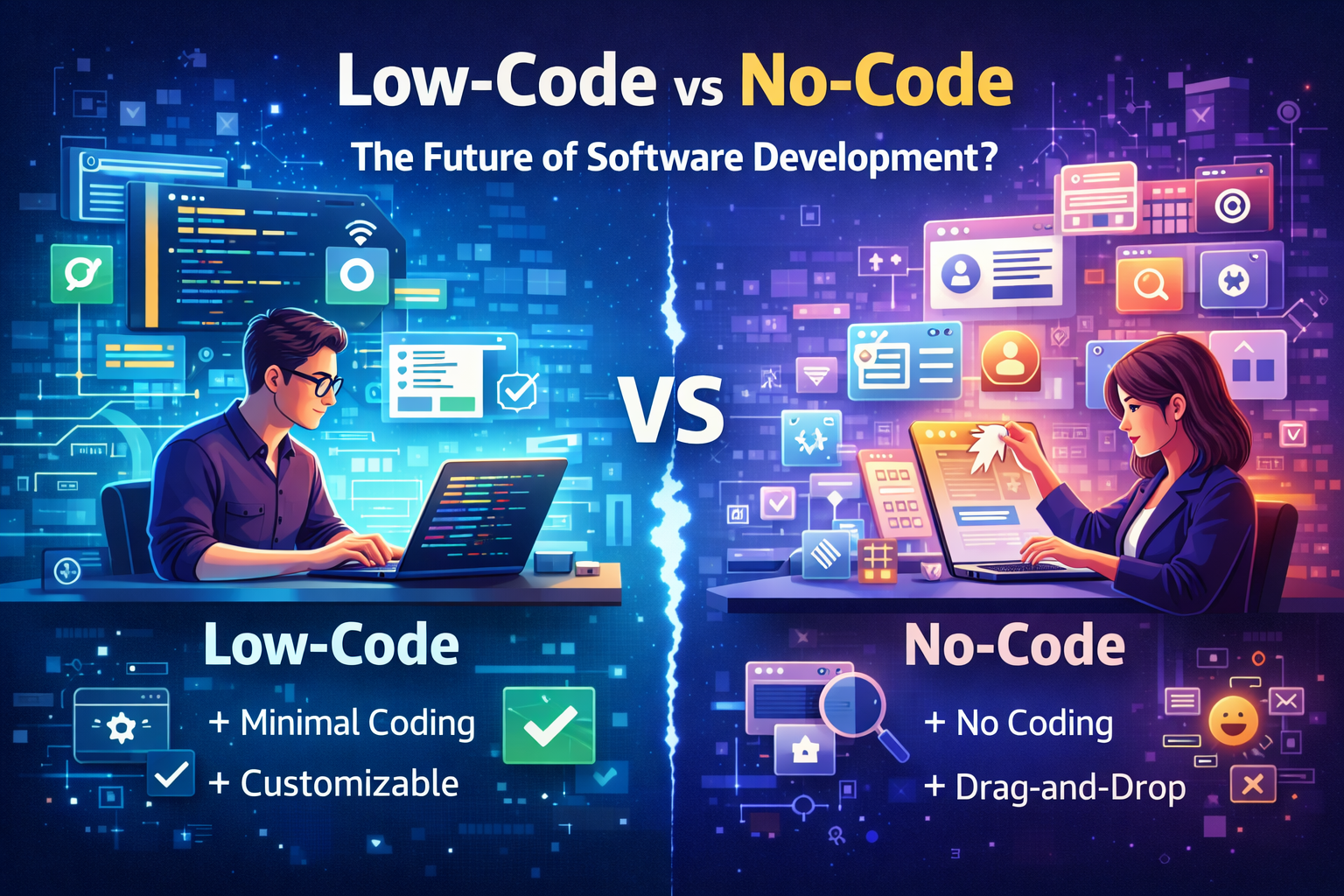
Low-Code vs No-Code Platforms: Are They the Future of Software Development?
Technology is evolving rapidly, and businesses today want faster, smarter, and more cost-effective solutions. This demand has given rise to Low-Code and No-Code platforms, tools that promise to build applications with minimal or no programming knowledge.
But the big question remains:
👉 Are low-code and no-code platforms truly the future of software development, or just a temporary trend?
Let’s explore.
What Are Low-Code and No-Code Platforms?
Low-Code Platforms
Low-code platforms allow developers to build applications using visual interfaces with minimal manual coding. Some logic and customization still require coding knowledge.
No-Code Platforms
No-code platforms enable users to create apps without writing any code, using drag-and-drop components and predefined workflows.
Examples include:
-
Website builders
-
Workflow automation tools
-
Simple mobile apps
-
Internal business dashboards
✅ Benefits of Low-Code & No-Code Development
1. Faster Development Time
Applications that once took months can now be built in days or weeks, helping businesses launch faster.
2. Reduced Development Costs
Since fewer developers are needed, companies save significantly on:
-
Development resources
-
Maintenance costs
-
Time-to-market expenses
This makes it ideal for startups and small businesses.
3. Empowers Non-Technical Users
Business teams can:
-
Create internal tools
-
Automate workflows
-
Update applications without developer dependency
This bridges the gap between business and technology.
4. Rapid Prototyping & MVP Creation
Low-code tools are excellent for:
-
Validating ideas
-
Building MVPs
-
Testing user flows
They complement traditional development methods.
❌ Limitations of Low-Code & No-Code Platforms
1. Limited Customization
Complex features, unique workflows, or performance optimizations are often restricted.
2. Scalability Challenges
These platforms may struggle when:
-
User traffic grows
-
Business logic becomes complex
-
Integrations increase
Enterprise-grade applications still require custom development.
3. Vendor Lock-In
Businesses depend heavily on platform providers, which can:
-
Increase long-term costs
-
Limit flexibility
-
Create migration challenges
4. Security & Compliance Risks
Not all platforms meet advanced security or compliance standards required for sensitive industries.
Low-Code/No-Code vs Traditional Development
| Feature | Low/No-Code | Traditional Development |
|---|---|---|
| Speed | Very Fast | Moderate |
| Customization | Limited | Unlimited |
| Scalability | Moderate | High |
| Security Control | Limited | Full |
| Cost (Initial) | Low | Higher |
The Smart Approach: Hybrid Development
The future isn’t low-code vs developers — it’s low-code + developers.
At Calcunext, we recommend:
✔ Low-code for prototypes & internal tools
✔ Custom development for scalable, secure systems
✔ Hybrid solutions for faster delivery without compromise
This balanced approach delivers speed and reliability.
Final Thoughts
Low-code and no-code platforms are powerful tools — but they are not replacements for professional developers. Instead, they act as accelerators in the development lifecycle.
Businesses that combine innovation with strong engineering foundations will lead the future.
🚀 Build the Right Technology with Calcunext
Whether you need a rapid MVP or a fully custom enterprise solution, Calcunext delivers technology that grows with your business.
👉 Contact us today to turn your ideas into scalable digital products.