



Introduction: Why React JS Has Become the Technology of Choice for Business Web Projects
Picture this: your business has a great product, a solid team, and a clear market opportunity. But your website is slow, your web app crashes under traffic, your development team spends weeks updating a single feature, and your users quietly abandon your platform for a competitor whose digital experience just feels better.
This scenario plays out thousands of times every day for businesses that built their digital presence on the wrong technology foundation. Choosing the right web development technology is not a purely technical decision — it is a business-critical one. And in today's landscape, one technology has emerged as the undisputed standard for building fast, scalable, business-ready web applications: React JS.
Developed and maintained by Meta (formerly Facebook), React JS powers some of the world's most visited and complex web applications — from Facebook and Instagram to Airbnb, Netflix, Dropbox, and thousands of fast-growing SaaS platforms. Its adoption by leading businesses is not accidental. React's architecture, performance characteristics, ecosystem depth, and developer talent availability make it the optimal choice for businesses that need web applications built not just to launch — but to grow.
In this comprehensive guide, we explore the top benefits of React JS development services, what they mean for your business specifically, and how partnering with the right website development company or website development agency can transform your digital product into a genuine competitive advantage.
The React JS Landscape: By the Numbers
Before exploring the benefits in depth, the sheer scale of React's adoption makes the strongest possible case for why forward-thinking businesses choose it.
|
#1 Most used frontend framework globally (Stack Overflow 2024) |
220K+ GitHub stars — most starred frontend library |
40%+ Of all websites use React in some form |
10M+ React developers worldwide |
These numbers matter for your business because they directly influence talent availability, third-party integration options, long-term support, and the ecosystem of tools your development team can draw from. Building on React means building on the most supported, most documented, and most actively developed frontend technology in the world.
Benefit 1: Blazing Fast Performance That Keeps Users Engaged
|
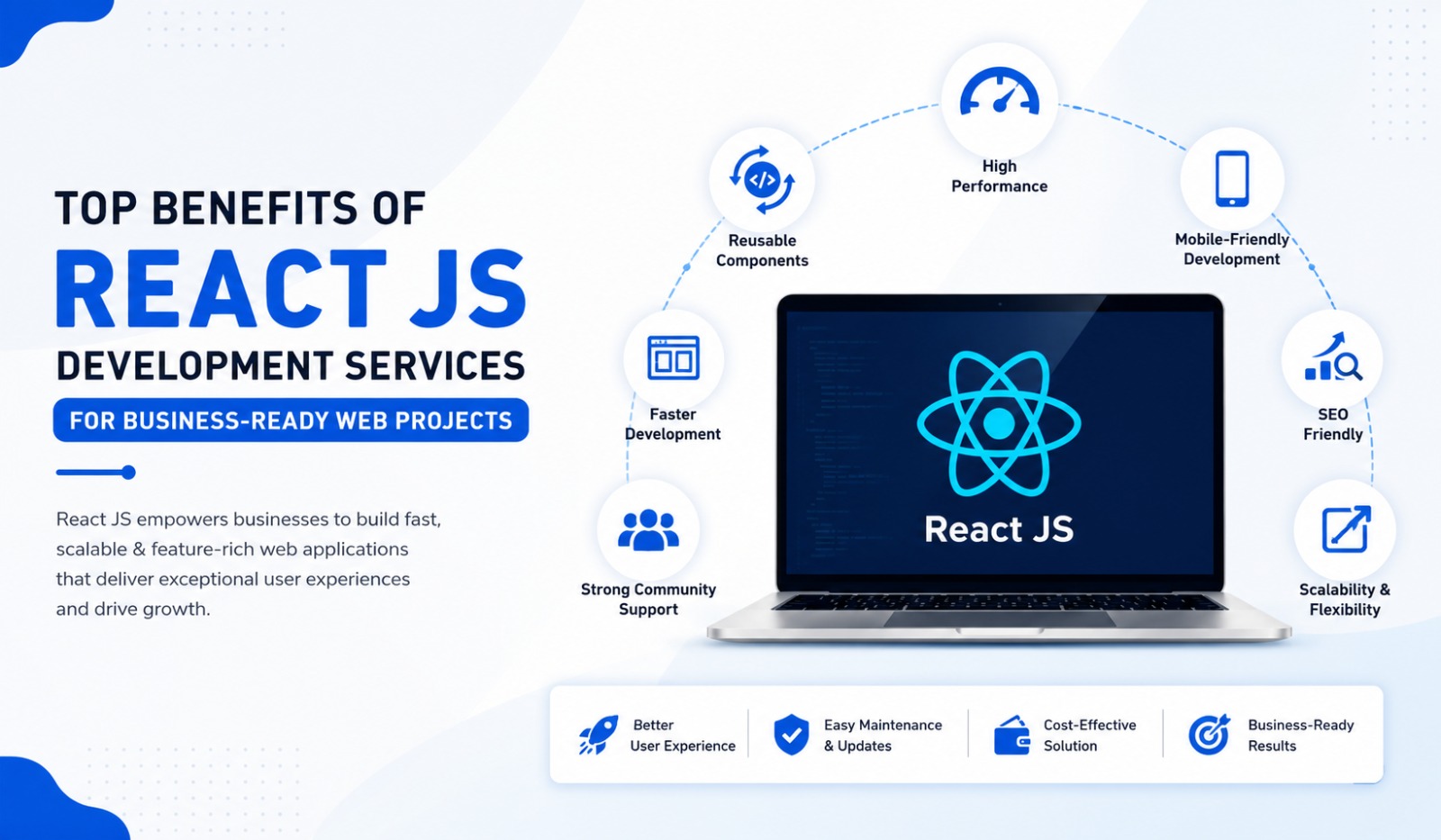
01 Virtual DOM — Speed That Users Feel Instantly React's Virtual DOM is one of the most commercially significant technical innovations in modern web development. Instead of re-rendering the entire page every time data changes (as traditional web applications do), React maintains a lightweight virtual representation of the actual DOM in memory. When data changes, React compares the virtual DOM with the real DOM, identifies exactly what has changed, and updates only those specific elements. |
The result is a user experience that feels instantaneous. Page interactions respond in milliseconds. Data updates appear without page reloads. Navigation between sections feels seamless. This kind of performance is not just aesthetically pleasing — it is commercially measurable.
|
1 sec Delay = 7% drop in conversions (Google) |
53% Mobile users abandon pages loading >3 seconds |
2x Faster load times = 2x lower bounce rate |
For businesses investing in React JS development services, performance is not a technical bonus — it is a direct revenue driver. A faster web application converts more visitors, retains more users, generates more repeat sessions, and ranks higher in Google search results through improved Core Web Vitals scores.
|
Business Impact Every 100ms improvement in page load time correlates with approximately 1% increase in revenue for eCommerce businesses, according to research by Deloitte. For a business generating INR 1 crore per month, a React JS-powered performance overhaul can translate directly to lakhs in additional monthly revenue. |
Benefit 2: Component-Based Architecture for Scalable, Maintainable Code
|
02 Build Once, Reuse Everywhere React's component-based architecture is one of its most powerful features for businesses planning long-term digital growth. Instead of building monolithic pages where every element is unique and individually coded, React applications are constructed from independent, reusable components — self-contained building blocks that can be used across multiple pages, features, and even entirely different projects. |
Think of components like Lego bricks. A Button component, a Navigation component, a Product Card component, a Search component — each built once, tested once, and then used wherever needed throughout the application. When a design change is required — say, updating the primary button colour as part of a brand refresh — the change is made in one place and reflected everywhere that component appears, automatically.
What Component Architecture Means for Your Business
- Faster feature development — new features are assembled from existing tested components rather than coded from scratch, dramatically reducing development time and cost
- Lower maintenance costs — bugs fixed in one component are fixed everywhere; updates to core elements propagate automatically across the entire application
- Design consistency at scale — every part of your application uses the same components, ensuring visual and functional consistency regardless of which developer built which feature
- Easier team scaling — new developers joining your project can immediately be productive by working on individual components without needing to understand the entire codebase
- Reusable across products — a well-built component library developed for your web application can be shared across mobile apps, marketing sites, and internal tools
|
Why This Matters for Your Website Development Agency Partnership When you engage a professional website development agency for React JS development services, a well-structured component architecture is one of the most valuable long-term assets they can deliver. It is the foundation that makes your application genuinely maintainable, evolvable, and cost-effective to enhance over years — not just months. |
Benefit 3: Exceptional User Experience with Single-Page Application Architecture
|
03 App-Like Experiences That Users Love React enables the development of Single-Page Applications (SPAs) — web applications that load once and then dynamically update content without full page reloads. The result is a fluid, app-like experience that feels native and responsive rather than the jarring page-by-page navigation of traditional websites. |
When a user navigates between sections of a React SPA, content updates instantly. No white flash. No loading spinner. No loss of application state. The experience is continuous, smooth, and engaging — precisely the kind of digital experience that increases session duration, reduces bounce rates, and improves conversion rates across every type of business application.
Industries Where React SPA Architecture Delivers Outstanding Results
- eCommerce platforms — product filtering, cart updates, and checkout flows that respond instantly without page reloads, dramatically improving the purchase journey
- SaaS dashboards — complex data-heavy interfaces where users navigate across multiple views and the application needs to maintain state seamlessly between them
- Financial applications — real-time portfolio dashboards, transaction histories, and reporting tools where data updates continuously without disrupting the user's workflow
- Healthcare portals — patient management systems, appointment booking platforms, and medical record interfaces where smooth, interruption-free navigation reduces user frustration
- Real estate platforms — property search and filtering experiences where users refine dozens of criteria and expect instant, responsive results
- EdTech applications — learning management systems where students move between lessons, quizzes, and progress tracking seamlessly within a single application shell
Benefit 4: Full Stack Development Power with React and Node.js
|
04 JavaScript End to End — Faster Delivery, Unified Teams One of React's most strategically significant advantages for business web projects is its natural partnership with Node.js on the backend. Together, React (frontend) and Node.js (backend) create a full JavaScript stack — meaning a single team of full stack web developers can build, maintain, and evolve your entire application using one programming language throughout. |
This unified stack approach has profound implications for both project delivery speed and long-term operational cost. Instead of maintaining separate frontend and backend teams with different skill sets, tool chains, and communication overhead — your business works with a single, coherent full stack web developer team that owns the entire application from database to user interface.
The Full Stack Advantage in Practice
- Faster development cycles — no context-switching between frontend and backend codebases; developers move fluidly across the stack to deliver features end-to-end
- Simplified hiring and team management — full stack web developer roles are well-defined and widely available, making team building and scaling more straightforward
- Unified codebase maintenance — single language (JavaScript/TypeScript) across frontend and backend reduces cognitive overhead and makes code reviews, refactoring, and debugging significantly more efficient
- Real-time features made easier — React + Node.js + WebSocket technology enables real-time features like live notifications, collaborative editing, and live dashboards with relatively straightforward implementation
- API-first architecture — React's component model pairs naturally with REST and GraphQL APIs, enabling clean separation of concerns and straightforward integration with third-party services
|
Choosing the Right Full Stack Web Developer Team When evaluating a website development company for your React project, look specifically for teams with proven experience across the full React ecosystem: React.js, Next.js, Node.js, REST/GraphQL APIs, and cloud deployment. A genuinely full stack team delivers faster, costs less to maintain, and understands the full context of your application — from server performance to pixel-perfect UI. |
Benefit 5: SEO-Optimised Web Applications with Next.js
|
05 Solving the SPA SEO Challenge — Server-Side Rendering One of the historical criticisms of React single-page applications was their SEO limitations. Traditional SPAs render content dynamically on the client side — meaning search engine crawlers sometimes struggled to index content that was not present in the initial HTML response. For businesses where organic search visibility is a critical acquisition channel, this was a genuine concern. |
Next.js — React's production-grade framework — resolves this comprehensively. Built on top of React, Next.js adds Server-Side Rendering (SSR) and Static Site Generation (SSG) capabilities that ensure search engines receive fully rendered, content-rich HTML with every request. The result is React-powered applications that rank as effectively as traditional websites — while still delivering the performance and interactivity benefits of React's component architecture.
Next.js SEO Capabilities That Drive Organic Growth
- Server-Side Rendering (SSR) — pages are rendered on the server and delivered as complete HTML to both users and search engine crawlers, ensuring full content indexability
- Static Site Generation (SSG) — pages pre-rendered at build time for maximum performance and perfect SEO signals, ideal for content-heavy pages like blogs, product listings, and landing pages
- Incremental Static Regeneration (ISR) — static pages that automatically regenerate when content changes, combining the performance of static pages with the freshness of dynamic content
- Automatic image optimisation — Next.js automatically optimises images for size, format, and lazy loading — directly improving Core Web Vitals scores that are Google ranking factors
- Metadata and structured data management — straightforward implementation of page titles, meta descriptions, Open Graph tags, and JSON-LD structured data that search engines use to understand and rank content
For businesses where search visibility drives customer acquisition — eCommerce, SaaS, professional services, real estate, healthcare — the combination of React JS development services and Next.js is not just technically optimal. It is commercially essential. The right frontend web developer services partner will build your React application on Next.js as a default, not an upgrade.
Benefit 6: Responsive Design Across Every Device and Screen
|
06 One Codebase, Every Screen — True Responsive Excellence With mobile accounting for over 60% of global web traffic — and significantly higher in mobile-first markets like India — responsive design is not a feature. It is the baseline expectation of every user on every device. React's component architecture makes building truly responsive web applications more systematic, more consistent, and more maintainable than any previous generation of web technology. |
React components combined with modern CSS-in-JS libraries, utility frameworks like Tailwind CSS, and responsive design systems like Material UI or Chakra UI give frontend web developer teams the tools to build interfaces that adapt flawlessly from a 320px mobile screen to a 4K desktop display — with the same React component serving every breakpoint, conditionally rendering the appropriate layout and interactions for each context.
What Responsive React Development Delivers for Your Business
- Consistent conversion paths across devices — users experience the same quality journey whether they discover you on mobile, tablet, or desktop — reducing device-specific drop-off points in your conversion funnel
- Improved Core Web Vitals on mobile — React's performance characteristics combined with mobile-first development practices deliver the page experience signals that Google uses as ranking factors
- Single codebase efficiency — one React application serves all devices rather than maintaining separate mobile and desktop codebases, reducing development and maintenance costs
- Accessible design as standard — React's ecosystem includes mature accessibility tooling that helps ensure your application is usable by users with disabilities — expanding your addressable audience and meeting legal requirements
- Progressive Web App capability — React applications can be enhanced to Progressive Web App standards, enabling offline functionality, push notifications, and home screen installation on mobile devices
Benefit 7: Rich Ecosystem and Third-Party Integration Capabilities
|
07 An Ecosystem That Solves Every Business Need React's extraordinary popularity has created one of the richest ecosystems in software development. Whatever your business needs — payment processing, authentication, real-time communication, data visualisation, CMS integration, analytics, maps, video, AI — there is a well-maintained, production-tested React library or integration pattern for it. |
This ecosystem depth is a significant commercial advantage. Rather than building complex functionality from scratch (expensive, time-consuming, and risky), experienced React developers select from battle-tested libraries that have been built, refined, and security-audited by thousands of developers across millions of applications. Your website development agency draws on this ecosystem to deliver features faster, at lower cost, and with greater reliability than bespoke implementations would allow.
Key Integration Categories Available in the React Ecosystem
- Payment processing — Stripe, Razorpay, PayU, Cashfree, and other payment gateways with pre-built React components and hooks
- Authentication — Auth0, Firebase Auth, Clerk, and NextAuth for secure, production-ready user authentication without building from scratch
- CMS integration — Contentful, Strapi, Sanity, and WordPress (headless) for content management that empowers non-technical teams to manage web content independently
- Data visualisation — Recharts, D3.js, Chart.js, and Victory for building interactive dashboards, analytics interfaces, and reporting tools
- eCommerce — Shopify Storefront API, WooCommerce, and custom cart implementations for headless commerce experiences
- Real-time features — Socket.io, Firebase Realtime Database, and Supabase for live notifications, chat, collaborative tools, and live data feeds
- Maps and location — Google Maps, Mapbox, and Leaflet for location-based features, store finders, and geospatial data visualisation
Benefit 8: Faster Time to Market with Reusable Component Libraries
|
08 Launch Faster Without Compromising Quality Speed to market is one of the most commercially critical factors in web project success. The window between idea and launch often determines whether a product captures a market opportunity or arrives too late. React's component architecture, combined with mature open-source UI libraries, allows experienced frontend web developer services teams to build production-quality interfaces in dramatically less time than traditional development approaches. |
Pre-built component libraries like Material UI, Ant Design, Chakra UI, shadcn/ui, and Radix UI provide hundreds of professionally designed, fully accessible, thoroughly tested UI components — buttons, forms, modals, tables, navigation, date pickers, data grids — that serve as the building blocks for complex business applications. Instead of designing and coding these from scratch, your development team assembles and customises them, focusing their effort on the unique features and business logic that differentiate your product.
How Component Libraries Accelerate Your Project Timeline
- MVP launch in weeks not months — core application interfaces assembled from pre-built components, allowing faster initial launch and earlier market validation
- Consistent design system from day one — pre-built libraries encode design system principles (spacing, typography, colour) that ensure visual consistency without extensive upfront design system work
- Reduced QA burden — widely-used library components are tested across thousands of applications and browsers, reducing the testing overhead for common UI patterns
- Easier iteration — standardised components make it faster and less risky to iterate on UI after launch based on user feedback and analytics
|
Choosing a Website Development Company That Understands Speed and Quality The best website development companies build custom component libraries on top of these foundations — combining the speed advantages of pre-built components with the brand-specific customisation your business identity requires. Ask any potential partner how they balance build speed with design quality, and how their component strategy will reduce your long-term development costs. |
Benefit 9: Long-Term Maintainability and Future-Proof Architecture
|
09 Built to Evolve — Not Just to Launch One of the most underappreciated aspects of technology selection for business web projects is long-term maintainability. A technology choice that is optimal for launch may become a significant liability three years later if the framework is deprecated, the developer community shrinks, or the architecture cannot accommodate new business requirements without complete rewrites. |
React completely eliminates this risk. As the most widely adopted frontend framework in the world, maintained by Meta and backed by a community of millions of contributors, React's long-term viability is more assured than any competing technology. Meta continues investing heavily in React's evolution — from React Server Components to the Concurrent Mode updates in React 18 and beyond — ensuring the framework remains at the frontier of web development capability.
Why React is a Future-Proof Choice for Your Business
- Continuous innovation — React 18's Concurrent Mode, Suspense, and Server Components represent the future of web rendering — and they are backward-compatible additions, not breaking rewrites
- Massive talent availability — the largest global pool of frontend developers means you will never struggle to hire, scale, or replace development resources
- TypeScript adoption — React's embrace of TypeScript adds static type checking that dramatically reduces runtime bugs in large-scale business applications and makes codebases significantly easier to maintain
- Micro-frontend architecture support — for enterprise applications, React's component model enables micro-frontend architectures where different teams own different application sections independently
- React Native bridge — businesses that need to extend their digital presence to mobile apps can leverage React Native, allowing significant code sharing between web and mobile without rebuilding from scratch
Benefit 10: Cost-Effective Development and Lower Total Cost of Ownership
|
10 Smart Economics for Business-Minded Web Projects Ultimately, every technology decision is a business decision. And React JS development services offer a compelling economic case for businesses of every size — from startups building their first web application to enterprises modernising complex legacy platforms. |
React's cost advantages operate at multiple levels simultaneously — from initial development through to long-term maintenance, team scaling, and feature evolution. When evaluated on Total Cost of Ownership rather than just initial build cost, React consistently delivers the strongest economic case of any frontend technology for business-critical web applications.
Where React Delivers Cost Advantages
- Lower development time — component reusability, rich ecosystem libraries, and excellent tooling reduce initial build time by 30-50% compared to building equivalent functionality without a framework
- Reduced maintenance cost — well-structured React applications with consistent component architecture are significantly cheaper to maintain than equivalent applications built with older frameworks or bespoke approaches
- Larger talent pool = competitive hiring — React is the most in-demand frontend skill globally, meaning you have more developer options at competitive market rates rather than paying premiums for specialists in niche frameworks
- Shared codebase across platforms — React and React Native code sharing between web and mobile applications reduces the cost of maintaining separate codebases for each platform
- Faster iteration = cheaper feature releases — the component architecture and hot module replacement development experience makes adding, modifying, and removing features faster throughout the product lifecycle
How to Choose the Right Website Development Agency for React JS Projects
Understanding React's benefits is one thing. Ensuring you work with a website development company capable of delivering those benefits for your specific business is another challenge entirely. Here is a practical framework for evaluating potential partners.
10 Questions to Ask a React JS Development Partner
- Can you show me live production React applications you have built — ideally in my industry or with similar complexity?
- What is your approach to component architecture and design systems — do you deliver a component library as part of the engagement?
- Do you use Next.js as standard for React projects, and how do you handle SEO and server-side rendering?
- What is your full stack capability — do you build React frontends with Node.js backends, or do you require a separate backend team?
- How do you handle state management in complex React applications — what is your approach to tools like Redux, Zustand, or React Query?
- What is your testing strategy for React applications — do you write unit tests, integration tests, and end-to-end tests?
- How do you handle responsive design — is mobile-first design baked into your development process from day one?
- What is your approach to performance optimisation — how do you measure and improve Core Web Vitals in your React projects?
- What does your post-launch support model look like — how do you handle bug fixes, security updates, and feature requests after delivery?
- Can I speak with two or three clients whose React projects you have delivered in the past 12 months?
|
Green Flags to Look For The best React JS development services providers will speak fluently about component architecture, testing practices, performance budgets, and long-term maintainability — not just visual design and launch timelines. A partner focused solely on delivery speed without discussing code quality and architectural decisions will cost your business significantly more in maintenance over time. |
React JS in Action: Real-World Business Use Cases
To make React's benefits concrete, here is how different business types are using React JS development services to build their competitive advantage.
eCommerce and Retail
React-powered storefronts deliver the fast, fluid product browsing experiences that modern shoppers expect. Instant filtering and sorting, live inventory updates, seamless cart and checkout flows, and personalised product recommendations — all delivered without page reloads that interrupt the shopping journey. Businesses on React-based headless commerce architectures consistently report higher conversion rates compared to traditional platform-based storefronts.
SaaS Products and Business Applications
React is the dominant technology for building SaaS dashboards and business applications. Data-heavy interfaces with real-time updates, complex multi-step workflows, role-based access controls, and interactive data visualisation — all areas where React's component model and state management capabilities provide a decisive development advantage over older frameworks.
Fintech and Financial Services
Financial applications demand a rare combination: exceptional performance, rock-solid reliability, security-first architecture, and interfaces that communicate complex data clearly. React's declarative approach to UI development, combined with TypeScript's type safety and the ecosystem's mature state management libraries, makes it the framework of choice for fintech teams building trading platforms, banking portals, investment dashboards, and payment processing interfaces.
Healthcare and MedTech
Healthcare applications have demanding requirements: complex data models, strict access controls, high-stakes workflows, and users — often clinicians — with zero tolerance for interface confusion or system unreliability. React's component architecture enables healthcare teams to build modular, well-tested interfaces that meet these demands while remaining maintainable and auditable over the regulatory timelines that healthcare software requires.
EdTech and Learning Platforms
Learning management systems, interactive course platforms, and educational tools represent some of the most complex UX challenges in web development — managing learner state, progress tracking, interactive exercises, video delivery, assessment logic, and community features simultaneously. React's architecture handles this complexity elegantly, and its component model enables EdTech teams to build reusable lesson components, quiz modules, and progress trackers that dramatically accelerate curriculum expansion.
Conclusion: React JS Is Not Just a Technology Choice — It Is a Business Decision
The ten benefits explored in this guide are not just technical advantages. They are business outcomes — faster time to market, lower development costs, better user experiences, higher conversion rates, stronger SEO performance, and a codebase that scales with your ambitions rather than constraining them.
Every business that builds on React today is investing in a foundation that has been validated by the world's most demanding digital products. A foundation maintained by the world's most active developer community. A foundation that will continue evolving with the needs of modern business for the foreseeable future.
Whether you are a startup building your first web application, a mid-market business modernising a legacy platform, or an enterprise team building a complex SaaS product — React JS development services, delivered by the right website development agency, can transform your digital product from a liability into your most powerful business asset.
The question is not whether React is the right technology for your business. For most business-critical web projects, it almost certainly is. The question is whether you have the right partner to unlock everything it can deliver.
|
Ready to Build Something Great with React JS? Whether you need a complete web application built from the ground up, a React-powered redesign of an existing platform, or expert frontend web developer services to augment your in-house team — the right website development company can deliver a React solution that performs, scales, and grows with your business. Get in touch to discuss your project and see how React JS development services can unlock your next stage of digital growth. |
Frequently Asked Questions
Q: What exactly are React JS development services?
A: React JS development services encompass the full range of activities involved in building web applications using the React JavaScript library — including UI/UX design, frontend component development, state management architecture, API integration, performance optimisation, SEO implementation via Next.js, testing, and deployment. A professional provider of React JS development services delivers not just functional code but a strategically architected, maintainable application built to meet your specific business requirements.
Q: How are React JS development services different from general web development?
A: General web development can involve any technology stack — WordPress, PHP, plain HTML/CSS/JavaScript, Angular, Vue.js, and dozens of other frameworks. React JS development services specifically leverage the React ecosystem — including Next.js, Node.js, React Native, and the extensive React library ecosystem — to build component-based, high-performance web applications with the particular characteristics that make React ideal for complex, scalable business applications.
Q: Do I need a full stack web developer or a frontend web developer for my React project?
A: The answer depends on your project's scope. If you need only a frontend React application that connects to an existing API or backend, frontend web developer services are sufficient. If your project requires building the backend API, database architecture, and authentication systems alongside the React frontend, you need a full stack web developer team with React (frontend) and Node.js (backend) expertise. For most new business web applications, a full stack approach delivers faster delivery and better long-term maintainability.
Q: How do I evaluate a website development agency for React JS projects?
A: Evaluate potential agencies on: their portfolio of live React applications (not just mockups), their technical process for component architecture and code quality, their approach to testing and performance optimisation, their experience with Next.js for SEO-critical projects, the seniority level of the developers who will work on your project, and their track record of long-term client relationships that indicate ongoing maintainability rather than just delivery-and-go engagements.
Q: What is the typical cost and timeline for a React JS web application?
A: Costs and timelines vary significantly based on complexity. A simple React web application (marketing site + basic interactive features) typically requires 4-8 weeks and INR 2-5 lakhs. A mid-complexity SaaS dashboard or eCommerce platform typically requires 3-6 months and INR 8-25 lakhs. An enterprise-grade application with complex integrations, custom design systems, and advanced features can require 6-12+ months and INR 30 lakhs upward. Always evaluate cost in terms of long-term TCO rather than initial build price — well-architected React applications cost significantly less to maintain and evolve.
Q: Is React JS the right choice for every web project?
A: React is the optimal choice for: complex interactive web applications, SaaS products, eCommerce platforms, data-driven dashboards, real-time applications, and any project where performance and scalability are commercial priorities. For very simple informational websites with no interactivity requirements, simpler approaches may be more cost-effective. A good website development company will recommend React when it genuinely serves your business needs — not simply because it is their default tool.